Best Vacuum Hose Removal Tool Guide for 2026
Discover the top vacuum hose removal tools designed to simplify disassembly of stubborn hoses. This guide highlights five reliable options, detailing their materials, compatibility, and key features to help you choose the right tool for automotive, marine, and home maintenance tasks. Each product section includes a quick link to the Amazon listing for easy comparison.
| Product | Key Use | Diameter Range | Durability |
|---|---|---|---|
| Toolwiz Hose Remover Pliers | Fuel, vacuum, heater hoses | 4 mm – 15 mm | High durability |
| Alkrsxi Hose Remover Pliers | Disassembly in tight spaces | 4 mm – 14 mm | Ergonomic design |
| EMSTAR Automobile Hose Remover | Oil, water, vacuum lines | 4 mm – 14 mm | Carbon steel construction |
| WORKPRO Hose Removal Pliers | Fuel and vacuum lines | 4 mm – 14 mm | Non-slip handle |
| OTC 4522 Stinger Tool | Vacuum hoses and fuel lines | 3/16″ – 1/2″ | Two-jaw design |
Toolwiz Hose Removal Pliers

Toolwiz Hose Removal Pliers are designed to easily extract stubborn hoses from tanks, radiators, pumps, and air cleaners. They handle fuel, vacuum, or heater hoses ranging from 0.16 inches to 0.59 inches (4 mm to 15 mm) in diameter. The tool aims to provide quick access to tight areas, reducing the effort required during disassembly.
Alkrsxi Hose Remover Pliers

[STREAMLINED HOSE DISASSEMBLY] Alkrsxi combines disconnecting hoses with handling hose clamps for quicker disassembly. [APPLICATION] Handles fuel, vacuum, or heater hoses from 5/32″ to 1/2″ (4 mm to 14 mm) in diameter, compatible with natural gas pipes, radiators, and other hard-to-remove lines. [EFFORTLESS AND EFFICIENT] Ergonomic design and precision engineering promote smooth operation, even in tight spaces, outperforming traditional methods.
EMSTAR Automobile Hose Remover Pliers

EMSTAR Hose Remover Pliers are crafted from high-quality carbon steel for durability and corrosion resistance. They support hoses from 4 mm to 14 mm (5/32″ to 1/2″), including trachea, heat radiating oil pipes, and other hard-to-remove lines. The tool is designed for efficient disassembly in tight spaces, combining strength with a practical grip.
WORKPRO Hose Removal Pliers

WORKPRO Hose Removal Pliers emphasize safe, efficient use with a user-friendly build. Made from durable materials, they resist deformation under heavy use. The non-slip PVC handle improves grip and reduces hand fatigue, enhancing overall work efficiency when removing fuel and vacuum lines from 4 mm to 14 mm in diameter.
OTC 4522 Stinger Removal Tool
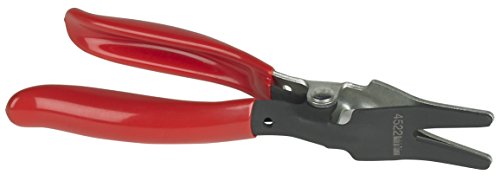
OTC 4522 Stinger is designed to remove 3/16 to 1/2 inch vacuum hoses or fuel lines from fittings. The tool features a two-jaw setup—use the black jaw to grip the hose and the silver jaw to push it off the fitting. It’s built for straightforward removal from fittings and tubing without excessive twisting or prying.
Buying Guide: Key Considerations for Vacuum Hose Removal Tools
Purpose and hose range: Confirm the tool supports the hose diameters you typically encounter, usually between 4 mm and 14 mm or 3/16″ to 1/2″.
Material and build: Carbon steel and robust alloys provide durability, especially for repeated use in automotive and marine environments. Look for corrosion resistance in damp or oily settings.
Ergonomics: A non-slip handle and balanced weight reduce user fatigue during extended jobs. Ergonomic design is particularly helpful in cramped spaces.
Access and leverage: Tools designed to reach tight areas with a straightforward grip typically save time and minimize damage to surrounding components.
Versatility: Some models combine hose removal with hose clamp manipulation or compatible functionality for multiple hose types.
Safety and compatibility: Ensure the tool’s jaws provide secure grip without biting into hoses, preventing additional wear or leaks. Check compatibility with common hose materials and fittings.
Value and warranty: Consider reliability, potential replacement parts, and any warranty when evaluating higher-priced options against budget-friendly choices.
Choosing between options: If you frequently work in tight spaces, prioritize ergonomic handles and compact designs (e.g., Alkrsxi). For heavy-duty disassembly in automotive settings, a carbon-steel tool with a solid grip (e.g., EMSTAR or Toolwiz) can be advantageous. For simple, fast tasks, OTC’s two-jaw approach may offer quick success.